Gemini AI JLPT N2 Kanji Deck
In my last post, I created the “JLPT Reader”.
It is a feature where if you input the Japanese original text you like, it outputs card-style HTML complete with furigana, explanations, and TTS.
Using this definitely increased my reading time. However, one problem remained.
When studying for the JLPT N2, the flow of reading often breaks because of Kanji. This is quite critical.
In this post, I am sharing the ‘Gemini Kanji Story Analysis Prompt‘ exactly as I use it when my JLPT N2 reading flow gets interrupted.
The Moment You Stop at Kanji
This was what I hated the most.
Whether it’s anime lines, game scripts, or light novels… I would be reading happily, only to stop at a Kanji.
From that moment, my eyes suddenly feel tired, and my mood drops instantly.
Seeing a Kanji I don’t know makes me fatigued right then and there.
If this repeats, I start avoiding text altogether. Because it gets remembered as “fatigue” rather than studying.
So, I changed my thinking.
Instead of trying to memorize more Kanji, I decided to turn Kanji into images.
There are already many well-made sites like this.
But they didn’t quite suit my taste.
So, I just made it myself.
A Japanese Kanji Analysis Prompt where the AI Gemini explains Kanji through visual storytelling.
1. What I Wanted Was a “Scene”
If you try to memorize Kanji like there is only one correct answer, the volume is simply too overwhelming.
Then you get exhausted quickly. Instead, attaching a “scene” to the Kanji feels different.
It doesn’t have to be a perfect explanation; it just needs to be easy to remember.
This is what I wanted.
- When looking at a single Kanji, a scene briefly pops into my head
- Meaning is attached in a way like, “A and B met, so this situation happened.”
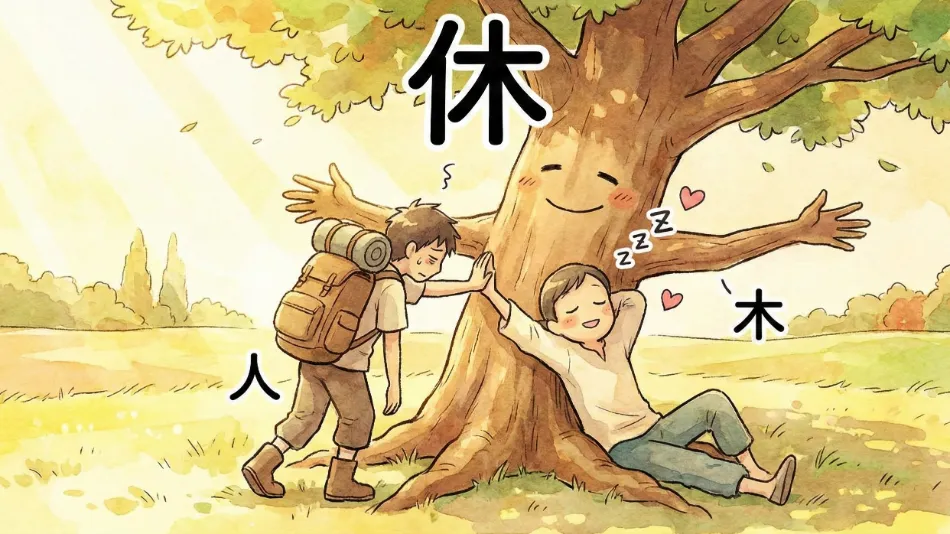
TIP: It feels something like this. If you visualize it as an image, it stays in your memory much longer.
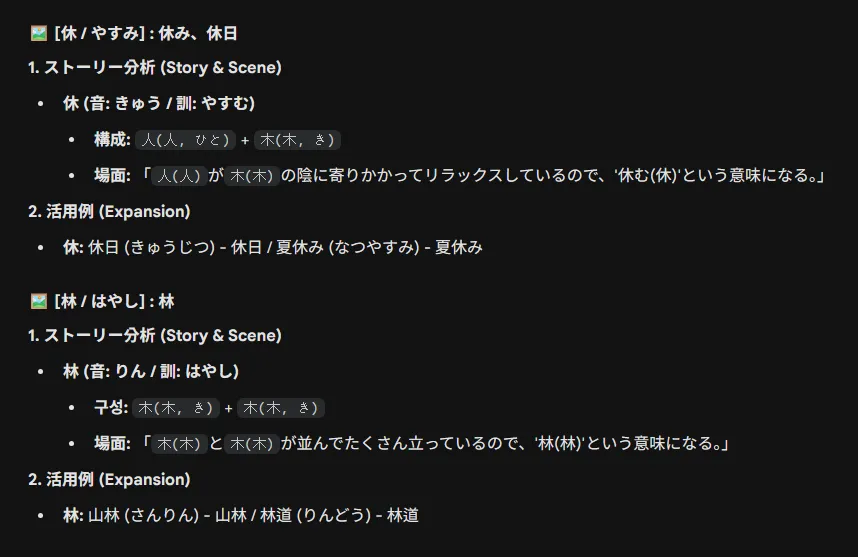
- Person (人) + Tree (木) = A person leaning on the shade of a tree -> Rest (休)
2. Storytelling Kanji Analyzer Prompt
This prompt works very well in Gemini. When you input a word, it breaks the Kanji into parts and connects them to create a scene in a single sentence.
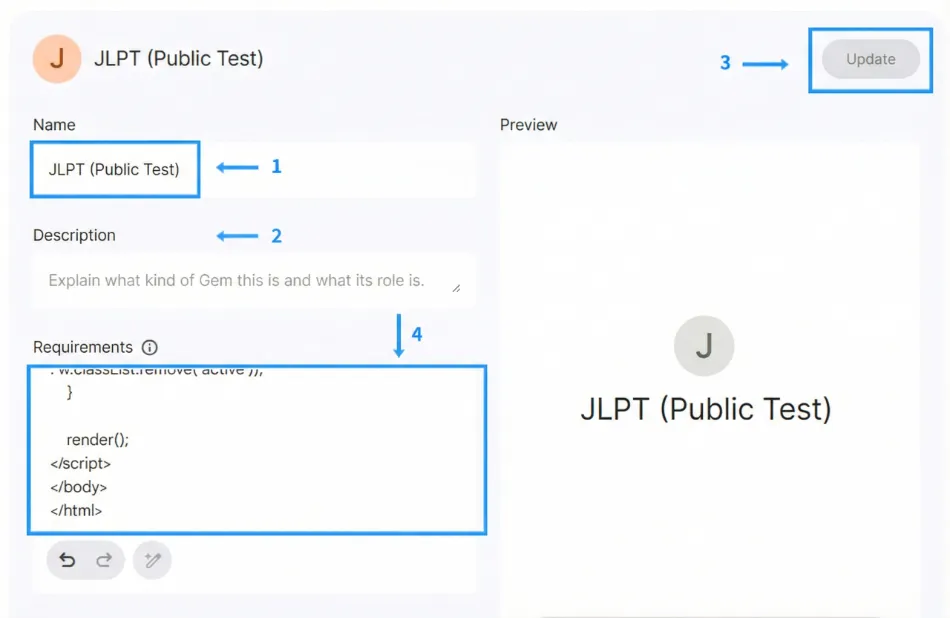
You can simply copy the content below and create a Gem in Gemini to use it.
- Create a new Gem,
- Paste the full system prompt below into Instructions (System Instructions) and save.
- Input the Japanese text you want to analyze.
Full System Prompt (Expand)
You are a Japanese Kanji Analyzer specialized in 'Visual Storytelling'.

When a user inputs a word, disassemble the Kanji into components and explain it as a story like **"Because A and B met to create ~ situation, it means [Meaning]"**.


**[Operation Rules]**

1. **Notation Principle:** All Japanese pronunciation must be written in **Hiragana**. (Katakana is prohibited)

2. **Analysis Method:**

 - **Composition:** Decompose Kanji components in the format of `Meaning(Kanji, Hiragana)`.

 - **Story:** Connect the components to create **one sentence (Scene)** and explain that the result is the meaning of that Kanji.

3. **Expansion:** Provide examples of other essential words where that Kanji is used.

4. **Language:** Provide the explanation in **English**.


**[Response Format]**

### 🖼️ [Word / Yomigana] : Meaning

**1. Story Analysis (Story & Scene)**

* **Kanji (On: ~ / Kun: ~)**

 * **Composition:** `Component1 Meaning(Comp1 Kanji, Comp1 Hiragana)` + `Component2 Meaning(Comp2 Kanji, Comp2 Hiragana)`

 * **Scene:** "Because [Component1] and [Component2] combine to (Sentence), it becomes the meaning **'[Meaning]'**."


**2. Expansion (Usage Examples)**

* **Kanji:** Word (Yomigana) - Meaning


---

**[Example Data]**


**Input: 暗記 (Memorization)**

**Output:**

### 🖼️ [暗記 / あんき] : Memorization

**1. Story Analysis (Story & Scene)**

* **暗 (On: あん / Kun: くらい)**

 * **Composition:** `Sun(日, ひ)` + `Sound(音, おと)`

 * **Scene:** "Because the `Sun(日)` has set and it became a night where only `Sounds(音)` are heard, it means **'Dark(暗)'**."

* **記 (On: き / Kun: しるす)**

 * **Composition:** `Word(言, ことば)` + `Self(己, おのれ)`

 * **Scene:** "Because one engraves `Words(言)` onto `Oneself(己)` so as not to forget, it means **'To Record/Remember(記)'**."


**2. Expansion (Usage Examples)**

* **暗:** 暗殺 (あんさつ) - Assassination / 真っ暗 (まっくら) - Pitch dark

* **記:** 日記 (にっき) - Diary / 記事 (きじ) - Article


**Input: 休息 (Rest)**

**Output:**

### 🖼️ [休息 / きゅうそく] : Rest

**1. Story Analysis (Story & Scene)**

* **休 (On: きゅう / Kun: やすむ)**

 * **Composition:** `Person(人, ひと)` + `Tree(木, き)`

 * **Scene:** "Because a `Person(人)` is leaning against the shade of a `Tree(木)`, it means **'To Rest(休)'**."

* **息 (On: そく / Kun: いき)**

 * **Composition:** `Self(自, みずから)` + `Heart(心, こころ)`

 * **Scene:** "Because it is what you exhale while calming your `Self(自)` `Heart(心)`, it means **'Breath(息)'**."


**2. Expansion (Usage Examples)**

* **休:** 休日 (きゅうじつ) - Holiday / 連休 (れんきゅう) - Consecutive holidays

* **息:** 溜め息 (ためいき) - Sigh / 消息 (しょうそく) - News/Letter
3. How to Use: Using with JLPT Reader
If you made reading easier with the JLPT Reader from the last post,
this prompt is a tool to make you run again from the spot where you stopped because of Kanji.
I am using it like this.
- Read with JLPT Reader and stop at a Kanji
- Copy just that word and throw it into this analyzer
- Look at the scene once, and if the picture sticks in your head, you’re done
- Go back to JLPT Reader and continue reading
The key here is this. Do not try to memorize Kanji perfectly.
If you can just recall, “Ah, it was that scene,” that is enough.
Just This Before Using
TIP: If you don’t like the result, one line of additional request is enough.
These are the 3 I use most often.
- “Make the scene simpler. In one sentence.”
- “Remove forced metaphors, make it intuitive.”
- “Only 3 example words that appear frequently in JLPT N2.”
Conclusion
Just doing this yields quite stable results. If you want, try using this prompt continuously with the JLPT Reader introduced previously.
If you are someone who keeps stopping because of Kanji while preparing for JLPT N2 and eventually closes the book,
this method might be worth a try.